

Dear friends and allies,
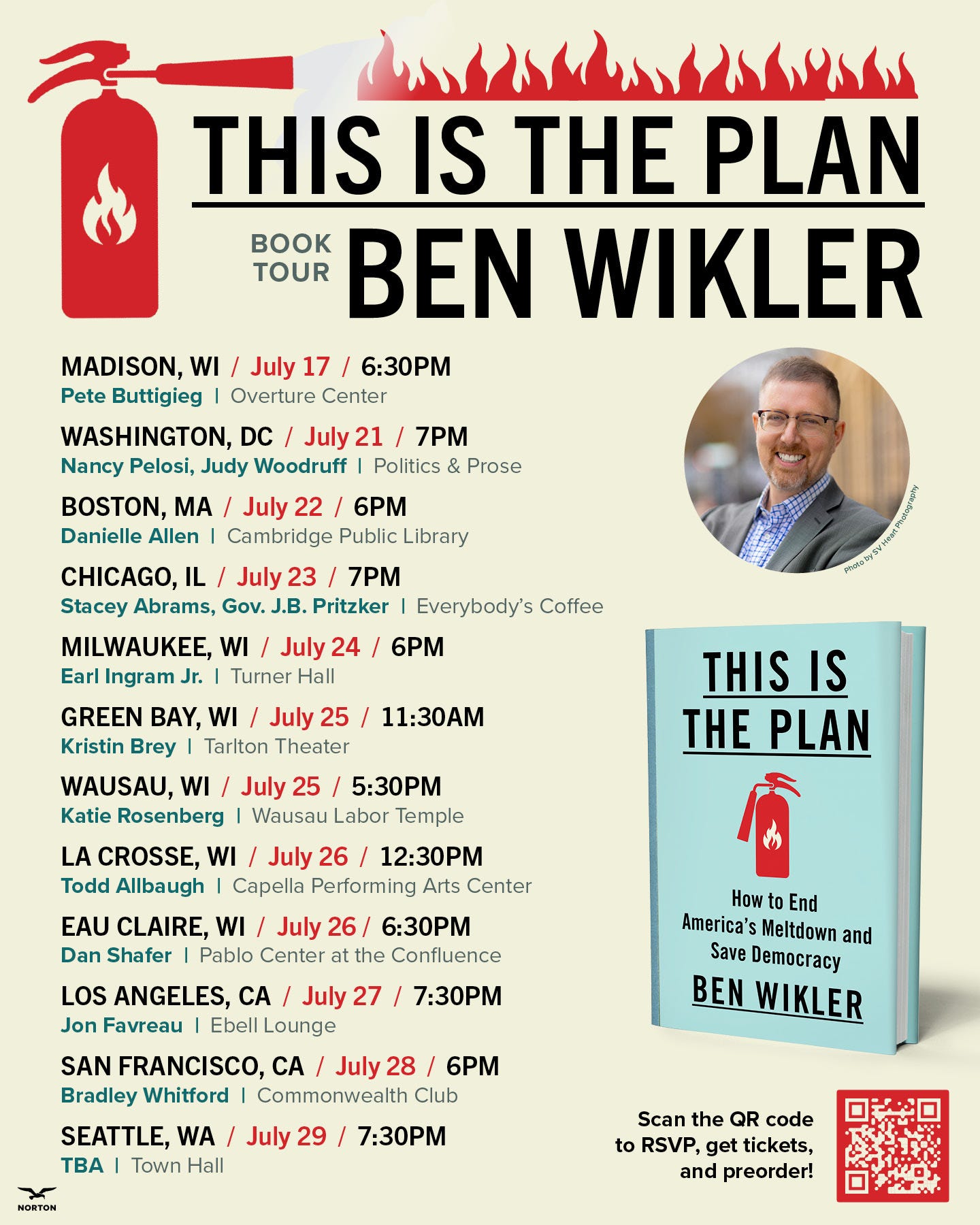
I’m thrilled to share my New York Times op-ed today drawing on my forthcoming book, This Is the Plan: How to End America’s Meltdown and Save Democracy—and to pull back the curtain on my book tour. I hope to see you at an event!
As I wrote in the op-ed, “A Three-Step Plan to Undo Trump’s Assault on Democracy,” “there are things every one of us can do, right now, to ensure democracy’s survival—and even flourishing—in our country.” I’m hoping that the book and the tour can galvanize more people to do more of those things.
If you feel the same way, please read and share the op-ed, pre-order the book, and then RSVP for a ticket to a book tour event near you. And I’d be grateful if you could spread the word—to your group chats, social media platforms, fellow organizing group or union members, and other networks.
Here’s the lineup of cities we’ll be visiting:
Friday, July 17: Madison, Wisconsin, 6:30 p.m. at the Overture Center, in conversation with Pete Buttigieg, in partnership with A Room Of One’s Own bookstore. RSVP for free here!
Tuesday, July 21: Washington, DC, 7:00 p.m. at the Politics and Prose bookstore, with Speaker Emerita Nancy Pelosi and senior correspondent of the PBS News Hour Judy Woodruff. First come, first seated; get details here!
Wednesday, July 22: Boston, Massachusetts, 6:00 p.m. at the Cambridge Library with Professor and author Danielle Allen. RSVP for free here!
Thursday, July 23: Chicago, Illinois, 7:00 p.m. at Everybody’s Coffee with Governor JB Pritzker and former Georgia Democratic leader Stacey Abrams. Get your tickets here!
Friday, July 24: Milwaukee, Wisconsin, 6:00 p.m. at the Turner Hall Ballroom with Civic Media host Earl Ingram, Jr. RSVP today!
Saturday, July 25: Green Bay, Wisconsin, 11:30 a.m. at Tarlton Theatre with 620 WTMJ radio host Kristin Brey. Reserve your spot now!
Saturday, July 25: Wausau, Wisconsin, 5:30 p.m. at the Wausau Labor Temple with former Wausau Mayor Katie Rosenberg. Get your free tickets here!
Sunday, July 26: La Crosse, Wisconsin, 12:30 p.m. at the Capella Performing Arts Center with former Civic Media host Todd Allbaugh. RSVP now!
Sunday, July 26: Eau Claire, Wisconsin, 6:30 p.m. at the Pablo Center with Civic Media host Dan Shafer. Reserve your spot here!
Monday, July 27: Los Angeles, California, 7:30 p.m. at the Ebell Theatre in conversation with Pod Save America host Jon Favreau. Buy your tickets here!
Tuesday, July 28: San Francisco, California, 6:00 p.m. at the Commonwealth Club with actor and producer Bradley Whitford. Purchase your tickets here!
Wednesday, July 29: Seattle, Washington, 7:30 p.m. at Town Hall Seattle. Buy your tickets now!
If you don’t see your city listed here, or if none of those stops work for you, stay tuned for other ways to catch me—I’ll also be doing private events, online events, media interviews, and future stops in other places. And if you’d like to work with me to organize an event, please get in touch!
For updates as the book’s publication draws closer, check out the book’s new website, ThisIsthePlan.com, or stay tuned to this newsletter. Not yet a subscriber? Sign up:
I’m so excited to get this out in the world. I just finished narrating the audiobook. The whole thing feels very timely.
If we want to save our democracy and end our country’s meltdown (which, if I know anything about you, is an interest that you and I share), we have a ton to do. Getting the message out is one key step. I hope you’ll join me on the journey.
Thanks so much,
Ben
No Twin Cities stop? Meanwhile, when is Ron Johnson's Senate seat up? You should run against him! He is a craven embarassment to WI.
Ben,
I think your NYT piece is one of the better descriptions I've seen of how democratic backsliding can be reversed. The Wisconsin example is especially valuable because it moves the discussion from abstract anxiety to concrete action.
That said, I think there is an important missing piece.
The article focuses heavily on rebuilding trust between citizens through relational organizing. I agree that matters. People are far more likely to listen to neighbors, friends, coworkers, and community members than to political advertisements or national party figures.
But many of the voters Democrats need to win back have lost trust not only in other people, but also in the Democratic Party itself.
If Democrats want to rebuild trust, they must first grapple honestly with why it was lost.
For millions of Americans, especially outside major metropolitan areas, the last several decades did not feel like a story of institutional success. Manufacturing jobs left for China and other low-cost countries. Workers who once earned middle-class wages in factories often found themselves in lower-paying service jobs with less stability, fewer benefits, and fewer opportunities for advancement.
As communities weakened, opioid addiction spread. Families and local governments struggled with the consequences while many institutions seemed slow to recognize the scale of the problem and slower still to respond. Infrastructure deteriorated. Main streets emptied out. Schools and hospitals closed. Yet voters were frequently told that globalization was working, the economy was fundamentally strong, and the country was moving in the right direction.
Whether every policy decision was right or wrong is almost secondary. The more important political fact is that many people concluded the institutions speaking to them were no longer speaking for them.
Those voters did not abandon institutions. They concluded the institutions had abandoned them.
This is also why I am skeptical of explanations that treat these voters as permanently lost. Iowa offers a useful reminder. Barack Obama carried the state twice, including many counties that now vote overwhelmingly Republican. Those voters did not suddenly become different people. What changed was their assessment of which party understood their problems, took their concerns seriously, and could be trusted to deliver tangible results.
That is why I think Wisconsin's experience is so important. I witnessed part of that transformation firsthand. The success was not simply that Democrats organized more effectively, although they clearly did. It was that people increasingly saw evidence that participation could produce tangible results. Better schools, safer streets, functioning infrastructure, responsive local leadership, and fairer elections helped convince people that engagement still mattered. Organizing opened the door, but institutional performance helped keep it open.
Rebuilding trust therefore requires more than better messaging or more effective organizing. It requires visible evidence that leaders have learned from past mistakes, are willing to acknowledge failures honestly, and can deliver practical improvements in people's daily lives. Trust is rebuilt through performance, not slogans.
**Competence creates credibility. Credibility creates trust. Trust creates the possibility of persuasion.**
To my mind, rebuilding that chain has to begin early in the process. If institutional trust cannot be rebuilt, electoral victories are likely to be fleeting. The goal is not simply to win the next election. It is to restore confidence that democratic institutions can improve the lives of ordinary citizens and are worthy of their trust.