

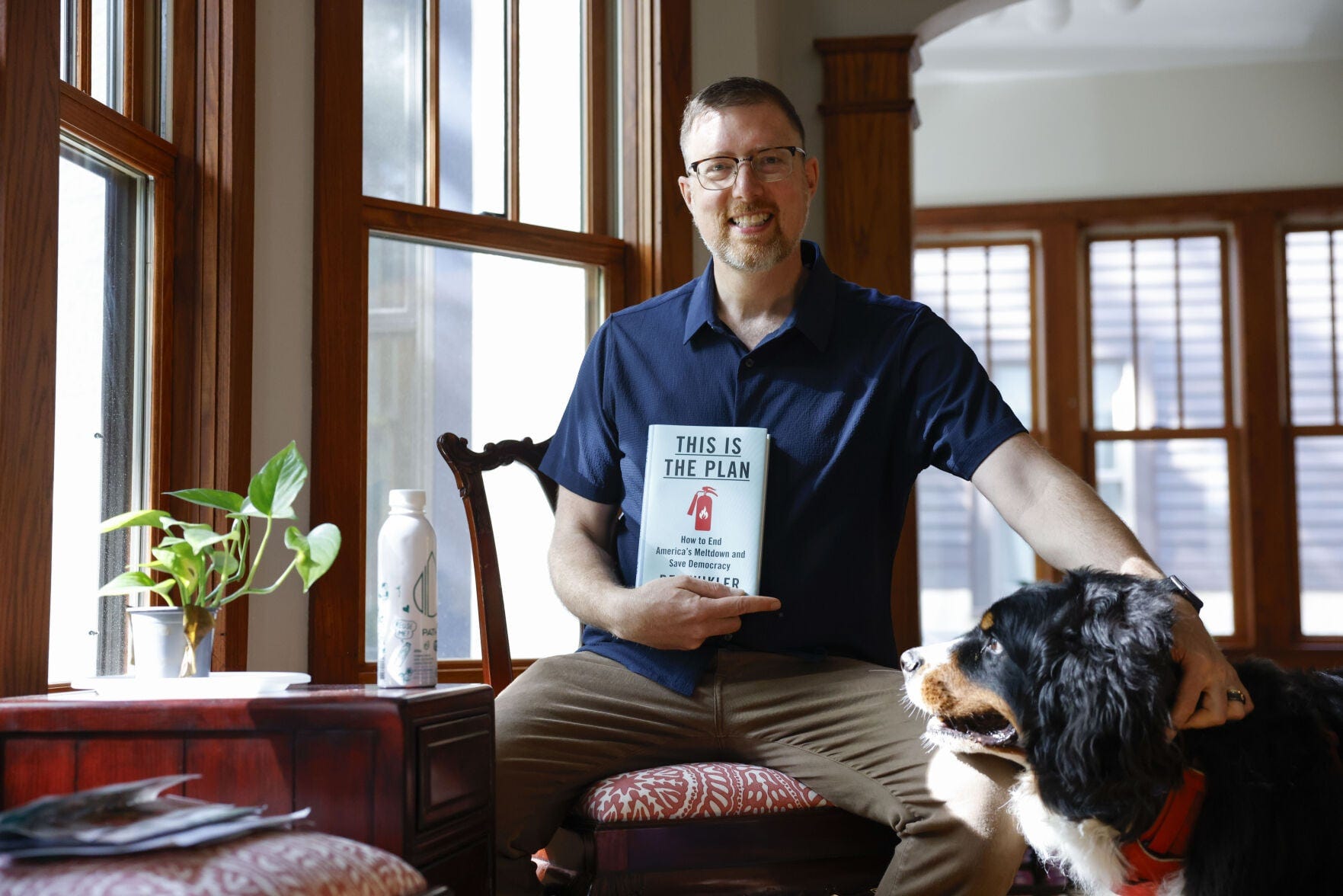
Want to read the plan in This Is the Plan, my book that officially launches on Tuesday, July 21? Today, my hometown newspaper, The Capital Times, published an excerpt from the introduction that I’m thrilled to share with you. If you enjoy this…
We’re already finding a ton of early interest in the book’s message. I joined Chris Hayes last night on MS NOW; discussed the plan on The Bulwark’s YouTube show/podcast yesterday; and was delighted by a feature story in The Isthmus this morning. And the book tour starts on Friday! Hope to see you on the road. Until then, get a taste of the book here:
A Wisconsin-born plan to save democracy
By Ben Wikler, in The Capital Times, July 15 2026
“I feel like this is one of those things that may not seem that it’s going to affect the entire destiny of humanity,” Elon Musk told the crowd in Green Bay, Wisconsin, on March 30, 2025, shortly after taking off a cheesehead. “But I think it will.”
Musk was visiting the Badger State in an all-out push to help a right-wing candidate win a state supreme court election. Polls would close two days later. Thanks to Musk’s $56 million investment, the race had become — by far — the most expensive judicial election in American history.
Musk thought that the race was vital to his plan to keep the U.S. House in Republican control by locking in gerrymandered maps.
Meanwhile, it was a little bonus for him that he had a Tesla lawsuit working its way through the state’s courts. A guaranteed state supreme court vote in his favor would pad his bottom line and perhaps pay back his investment in the race.
But the election was also important for a very different reason: It was the first major election of the second Trump term.
It came at a moment when Democrats nationally were shell-shocked, terrified, and consumed by infighting. It was the first test of whether Trump, Musk, and their gang of MAGA billionaire buddies had figured out a way to permanently short-circuit American politics — or whether regular people could still fight back.
Musk knew that the race had enormous direct stakes: If his candidate, Brad Schimel, were to beat Judge Susan Crawford, who had been endorsed by Democrats, Schimel would tip the majority on the Wisconsin Supreme Court. He’d be set to cast the court’s decisive vote in cases that could rerig the political system in the most evenly divided state in the country, the state that could tip presidential elections, U.S. Senate majorities, and the fate of American democracy.
Two days after Musk’s visit, Schimel lost to Crawford in a ten-point landslide.
How? Three reasons. Musk and Trump had ignited a backlash. Crawford ran a spectacular campaign. And a state where Democrats and allies of democracy had been organizing nonstop for the previous eight years had demonstrated that it could get up off the mat and fight back.
“As a little girl growing up in Chippewa Falls,” Crawford told an ecstatic crowd at her victory celebration, “I never could have imagined that I’d be taking on the richest man in the world for justice in Wisconsin — and we won!”
* * *
What our country is going through now— a soul-ripping, mind-rending nightmare of corrupt authoritarianism in which a far-right candidate takes power on the back of economic discontent and culture wars and then uses his victory to claim a mandate for a sweeping, lawless assault on democracy itself — happened first in Wisconsin.
In Wisconsin, there was a time not too long ago when it seemed like all hope was lost. A time when every day brought a new avalanche of migraine-inducing headlines, when relatives broke off contact with each other because of the bitterness of their political disagreements, and when regular people felt powerless as far-right billionaires ripped the state apart and deposited the most valuable chunks in their offshore bank accounts.
Wisconsin circa 2011–2017 was the United States of America in the Trump era.
But we Wisconsinites fought back.
We. A big “we.” We, those who believed that government should be by, of, and for the people, not just ultra-rich insiders. We — Democrats, independents, and non-MAGA Republicans who think their party has gone off the deep end. We: thousands, ultimately hundreds of thousands, of people from all walks of life who made it their job to unshackle democracy in their state and end Wisconsin’s meltdown.
It took years. But we fought, and we fought, and we fought. And, in time, we won, and we won, and we won. That years-long struggle—the permanent grassroots campaign that we built together — was the backstory of how Wisconsinites beat the world’s richest man and kicked off the nationwide political uprising that has marked the second Trump term.
The strategy that worked in Wisconsin can work nationwide. And it’s urgent.
Fights for political power at every level of government are, in fact, interconnected. American political power is like the energy flowing through an electrical grid: short out one substation, and the lights flicker in the next neighborhood. The winners of races for local office oversee decisions about election administration that affect presidential campaigns. Senate filibusters block legislation that would end the gerrymandering of state legislatures. Governors and secretaries of state and state supreme courts make decisions that determine who controls the U.S. House and the Senate. The outcomes at every level depend on the outcomes at every other.
In a country where vast power hinges on tiny margins in seemingly obscure elections, understanding this underlying structure — a system glimpsed by the public, if at all, only briefly and rarely — is critical for anyone who wants to fight for real change.
For decades, the right has been playing on all of these levels at once. It’s time to fight back in kind.
If we’re serious about organizing and campaigning our way to a new birth of American democracy, this is the plan:
First, in 2026, win in the states. Elections are run by states, not by the federal government. Which means that, even if he dreams of doing so, Trump doesn’t have the power to cancel elections. And if we on Team Democracy win state and local offices in 2026, we can dictator-proof state and local government to ensure that the 2028 election is free and fair. While we’re at it, let’s also win majorities in the House and Senate in 2026, which would prevent any democracy-undermining legislation at a national level and enable us to initiate long-overdue oversight of this administration’s brazen corruption and lawlessness.
Then, in 2028, while expanding our hold in the states, we need to elect a president, House, and Senate ready to take action. Once they’re sworn in, it’s time to abolish the filibuster; reform the U.S. Supreme Court (via term limits and/or additional justices); and pass decisive democracy and anti-corruption reforms, from a national ban on partisan gerrymandering to proportional representation in the House to voting rights protections; enact (District of Columbia) statehood and invite Puerto Rico to conduct a statehood referendum; and establish national safeguards for union organizing that ensure no future Scott Walker acolyte can smash unions at a state level.
All of us will have a role to play — not just to elect the leaders who will pass these laws, but to ensure that they follow through on their promises. Even as you’re working on local, state, and federal elections, you’ve also got to push your elected officials at all levels to pass policies that protect democracy and deliver for regular people.
And then you should expect a backlash in 2030 — which we must work to blunt. But 2030 isn’t just an election year — it’s also the decennial census. Which means every state legislative and congressional district will be redrawn (and Electoral College votes reapportioned) before 2032. If we haven’t passed landmark democracy reforms in 2029, this could mean another decade of rigged government just like the one that followed the Tea Party wave of 2010. But if we’ve banned gerrymandering in 2029, we won’t have to fear a wave of nationwide gerrymandering after the 2030 census. In fact, 2031 could bring the most fair set of maps, at every level of government, of all time.
Along the way, via action at the state level, we can pass the National Popular Vote Interstate Compact in enough states to ensure that the winner of the national popular vote gets the keys to the White House.
Thus, by 2032, we’ll have the first small-d democratic elections in American history. A new dawn for American democracy rather than authoritarian breakthrough and doom.
Within a few years, we could conduct presidential elections in which every American’s vote counts the same, rather than Wisconsinites wielding vast power while New Yorkers, Texans, Wyomingites, and Vermonters wield none. We could see a U.S. Supreme Court that is no longer beholden to the far right. We could be represented by a House that actually represents us, with gerrymandering a thing of the past, and a U.S. Senate in which the majority actually rules. And the same could be true of every state legislature. Every state could have, as the Constitution requires, a republican form of government. A government that, as James Madison wrote in Federalist No. 39, “derives all its powers directly or indirectly from the great body of the people”—in other words, the majority.
And if we do all that — if we save democracy — then we’ll have an even bigger task ahead of us: to end America’s meltdown.
By “meltdown” I mean the overpowering sense that our country, and specifically our government, doesn’t work for regular people. That the American Dream is dead, that the system is rigged, that working hard won’t get you anywhere, and that we can no longer, as a nation, do hard things to create a better future. That too many can’t afford the things that everyone needs. The feeling, underscored by the news each day, that our government is now being weaponized against us, especially the most vulnerable, on behalf of a tiny and spectacularly wealthy few that want to lock up all the money and power for themselves.
We’re already living through an era in which vast affluence flows to a miniscule elite at the very top, an economy even more unbalanced than that of the Gilded Age over a century ago. Now change is accelerating, fueled most of all by artificial intelligence. Everything’s up for grabs. As we careen into the AI age, we need a government that works for all of us — not just for Elon Musk.
To pull the government back from Trump and his MAGA billionaire cabal, we can take a page from the Progressive Movement that Wisconsin first spearheaded in the early 20th century. We must become today’s Fighting Bobs and Fighting Barbaras. Or better yet, we can take a page from Susan Crawford and the Wisconsinites who stood beside her. We’ll need to fight our way through — out-organizing and out-communicating the other side, at every level of government, in every geography and every community, all the time. Exactly as Wisconsin has been doing, year by year.
This requires a permanent campaign. It might sound exhausting at first blush. But if enough of us get involved and add what little we can — if, say, millions of people take action, even just for a few hours a month — it’s enough to move mountains.
And here’s the thing: Taking action feels good.
Becoming part of something greater than yourself — living in service to your highest ideals — doesn’t just make you a hero. It also generates exuberance. Collective action fosters collective joy. Doing your part to defend democracy requires rebuilding community, connecting with people whom you would never have otherwise met, finding common cause with people whose paths you’d never have otherwise crossed. It’s like Facebook was supposed to be, twenty years ago, back before it became a giant sucking whirlpool of AI slop and human misery.
The secret at the heart of American politics is that the number of votes separating a future of crisis, unraveling, and tyranny from a future of democracy, opportunity, and freedom is agonizingly small. So small, in fact, you and I and a few of our closest friends have, together, the power to change it.
Let the pundits obsess over the margin of error in the polls. It’s time for friends of democracy and the working people who make our nation great to roll up our sleeves and fight to win by the margin of effort.
Ben Wikler is a Madison resident and former chair of the Democratic Party of Wisconsin.

Ben — I agree with most and ask myself: the "why isn't this guy running the DNC"
Having door knocked on maybe 40,000 doors in rural and small town and college and 'urban' Iowa, I offer my perspective. Just let people see your face and genuine introduction. My problem with party 'Real listenin" is that it only happens when the people asking the questions don't already think they — or their bosses — have all the answers. That's the consultant's actual problem.
Team of Rivals worked because Lincoln brought in people who'd beaten him and might again. Somebody ought to try that and bring you and others on board at DNC.
If Democrats had any sense you would chair the national DNC. Any chance of that happening? Wait, I think I know the answer to that. Thx for your work